
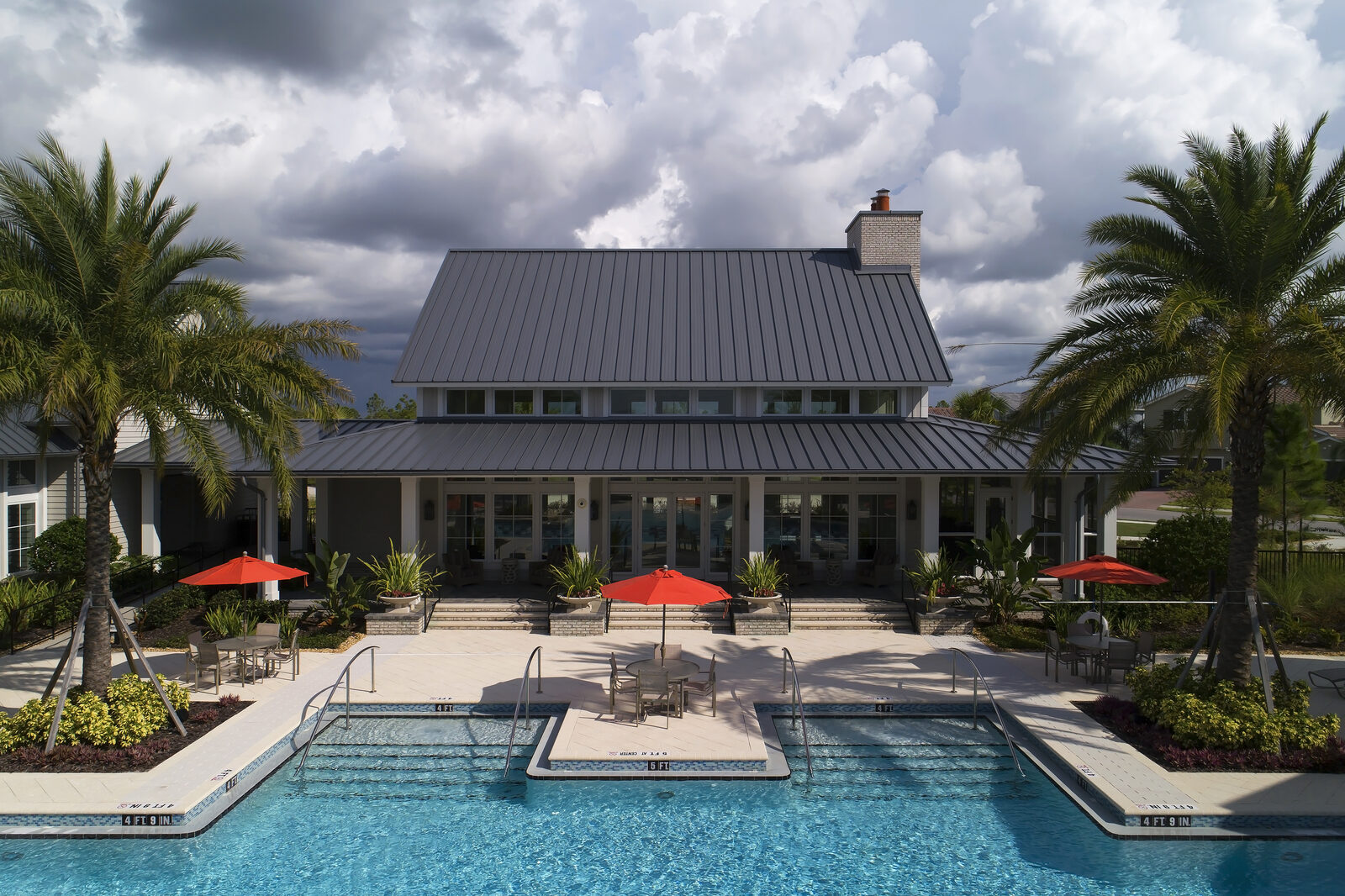
Climate & Weather in Florida
Florida has a humid subtropical climate in the north/central regions and tropical climate in the south (Keys, southern Miami-Dade). Defining features for roofing decisions: near-annual exposure to Atlantic hurricane season (June–November) with sustained high winds and wind-borne debris; intense, near-daily UV and solar-heat load; extremely high humidity and heavy convective rainfall; frequent lightning and severe thunderstorms that can spawn tornadoes/waterspouts; and pervasive coastal salt-air corrosion across virtually the entire peninsula (the state has more coastline exposure than any other US state). Snow load and wildfire/WUI risk are minimal to negligible statewide, making wind, water intrusion, heat, and corrosion resistance the dominant design drivers rather than structural snow load or fire-spread from wildland fuels.
Weather Perils to Plan For
Hurricane / tropical storm wind
Statewide exposure; coastal wind-borne debris regions (most of the peninsula and coastline) require impact-rated roofing/opening protection. Miami-Dade and Broward counties sit in the High-Velocity Hurricane Zone (HVHZ), the strictest wind code jurisdiction in the US, requiring NOA-approved (Notice of Acceptance) roofing assemblies. Roof-to-wall uplift connections (hurricane straps/clips) are mandated statewide under the Florida Building Code.
Hail
Less frequent/severe than in Plains/Midwest hail states but does occur, especially in Panhandle and North/Central Florida during severe thunderstorm season; Class 4 impact-rated panels are recommended and often insurance-incentivized.
Tornado / waterspout
Florida has one of the highest per-square-mile tornado frequencies in the US (mostly weak EF0-EF1 tornadoes and hurricane-spawned tornadoes/waterspouts), reinforcing the need for high uplift-resistance roof assemblies.
Wildfire / WUI
Some wildfire risk in rural/interior scrub and Panhandle timberland areas, but negligible compared to Western states; not a primary driver of residential roofing material choice statewide.
Heavy snow load
Not a design consideration anywhere in the state.
High UV / solar heat
Among the highest UV index and cooling-degree-day loads in the continental US; reflective/cool-roof metal coatings (e.g., Cool Roof-rated PVDF/Kynar finishes) are heavily marketed for energy-bill reduction.
Coastal salt-air corrosion
Nearly the entire state is within salt-air influence given the peninsula geography; aluminum or coated/Galvalume steel with marine-grade coatings, plus stainless fasteners, are recommended within several miles of the coast to prevent premature corrosion.
Recommended Metal Roof Types
Standing seam metal roofing (steel or aluminum, mechanically seamed, concealed fasteners)
Best-in-class wind uplift performance, no exposed fasteners to work loose or corrode, qualifies for the strongest wind-mitigation insurance credits, and is the assembly type most likely to carry Miami-Dade NOA / HVHZ approval and Florida Product Approval (FL#) listings needed for HVHZ and wind-borne debris regions.
Aluminum standing seam / panels
Naturally corrosion- and rust-proof, making it the preferred substrate within a few miles of saltwater (barrier islands, Keys, both coasts) where steel would need heavier coating protection; also lightweight for retrofit over existing structures.
Galvalume / coated steel standing seam
Cost-effective alternative to aluminum for inland and non-immediate-coastal homes, with strong corrosion resistance from the aluminum-zinc coating and widely available FL Product Approval listings.
Stone-coated steel metal shingles/tile profiles
Popular in HOA communities and Mediterranean-style neighborhoods that require a tile or shake appearance, letting homeowners get metal's wind/impact performance while meeting deed-restricted aesthetic requirements.
PVDF (Kynar 500)-coated panels in any of the above
The reflective, fade- and chalk-resistant coating is heavily recommended for Florida's intense UV and heat load, supporting Cool Roof energy performance and long-term color retention versus SMP or unpainted coatings.
Building Code, Wind & Fire
| Building Code Notes | Florida Building Code (FBC) 8th Edition (2023) is currently enforced statewide and remains in force through 2026; a 9th Edition is anticipated in late 2026. Key roofing provisions include sealed/self-adhering underlayment over the full deck as a secondary water barrier, minimum R-20 roof-plane insulation where the attic is within the building envelope, and enhanced hurricane-rated roof-to-wall connections. HVHZ jurisdictions (Miami-Dade, Broward) require Miami-Dade NOA product approval; all other jurisdictions require Florida Product Approval (FL#) listing for the specific panel/system and wind zone. Homeowners and roofers should verify NOA/FL# approval for the exact metal panel profile and fastening pattern proposed, since approvals are project- and wind-zone-specific. |
|---|---|
| Wind Requirements | Governed by the Florida Building Code (FBC), 8th Edition (2023), in effect through 2026 with a 9th Edition anticipated late 2026. Statewide, roofing assemblies must meet wind uplift and wind-borne debris protection requirements tied to the local Ultimate Design Wind Speed (ranging roughly 130-180 mph depending on location). Roof-to-wall connections must use enhanced uplift hardware (hurricane clips/straps) rather than relying on nails alone. Sealed roof decking (self-adhering underlayment across the full deck) is required in many jurisdictions as a secondary water barrier. Miami-Dade and Broward counties fall within the High-Velocity Hurricane Zone (HVHZ), the most stringent wind-testing regime in the US, requiring products to hold a Miami-Dade Notice of Acceptance (NOA); outside HVHZ, products need Florida Product Approval (FL#) numbers verifying compliance with the FBC. Coastal and peninsula areas largely fall in the Wind-Borne Debris Region, triggering additional impact-protection requirements. |
| Fire Requirements | Florida Building Code requires roof coverings to carry a minimum Class A, B, or C fire rating depending on local jurisdiction (most residential jurisdictions require at least Class A for best code compliance and insurance treatment); metal roofing systems are inherently noncombustible and typically achieve Class A fire ratings as part of a tested assembly. Wildfire/WUI-specific fire-hardening codes (as seen in California) are not a material factor in Florida given minimal wildland-fire exposure, so fire rating here functions mainly as a general code/insurance checkbox rather than a wildfire-defense driver. |
Insurance & Adoption
Typical Installed Cost
Statewide installed cost is roughly $8-$20 per sq ft depending on material and profile: corrugated/exposed-fastener steel panels run about $3.50-$8/sq ft installed (roughly $8-$16/sq ft including labor per some vendor breakdowns); standing seam steel or aluminum typically runs $10-$20/sq ft installed (some premium/HVHZ-compliant installations reaching $10-$35/sq ft); copper and zinc are the luxury tier at roughly $14-$40/sq ft. For an average ~2,000 sq ft Florida home, total standing seam project costs commonly fall in the $20,000-$40,000 range. Costs run higher in HVHZ jurisdictions (Miami-Dade/Broward) due to NOA-compliant materials, permitting, and inspection requirements.
Popular Metal Roof Colors in Florida
- Galvalume / silver-gray (unpainted, natural metallic - very common on standing seam)
- Charcoal gray / graphite
- Matte black
- Bone white / classic white
- Colonial red / barn red (traditional Florida vernacular and Keys aesthetic)
- Forest/hunter green
- Terracotta / clay red (used on stone-coated metal shingle profiles to mimic Mediterranean barrel tile)
- Bronze / copper-tone (for luxury standing seam and copper installations)
- Cool-roof reflective light colors (white, light gray, light tan) increasingly favored for energy-code and utility-bill reasons
Common Home Styles
- Florida vernacular / "Cracker" style (low-pitch or moderate-pitch gable roofs, deep overhangs, elevated on piers in older coastal/rural homes)
- Mediterranean Revival / Spanish Colonial (barrel tile-look profiles, low-to-moderate pitch, stucco walls, common in South Florida)
- Ranch and ranch ranch-hybrid ('Florida ranch') - single-story, low-pitch hip or gable roofs, CBS (concrete block stucco) construction, dominant mid-century tract-home style statewide
- Coastal / Key West style (metal roofs historically standard, elevated construction, wraparound porches, common in the Keys, Gulf Coast, and barrier islands)
- Modern coastal contemporary (clean-line standing seam roofs, impact glass, popular in new coastal construction and luxury remodels)
- New construction production-builder Mediterranean/Contemporary hybrids in master-planned communities (Orlando, Tampa, SW Florida)
Metro Areas We Serve in Florida
Fort Lauderdale / Broward County
Broward County
Fort Myers / Cape Coral
Lee County
Jacksonville
Duval, St. Johns, Clay
Lakeland-Winter Haven
Polk County
Miami / Miami-Dade
Miami-Dade County
Naples-Marco Island, FL Metropolitan Statistical Area (Collier County)
Collier County
Orlando
Orange County, Seminole County, Osceola County
Pensacola-Ferry Pass-Brent, FL Metropolitan Statistical Area (Panhandle)
Escambia County, Santa Rosa County
Sarasota / Bradenton
Sarasota County, Manatee County
Space Coast (Melbourne-Palm Bay-Titusville, FL Metropolitan Statistical Area)
Brevard County
St. Petersburg / Clearwater
Pinellas County
Tallahassee
Leon County, Gadsden County, Wakulla County
Tampa-St. Petersburg-Clearwater
Hillsborough County, Pinellas County, Pasco County
West Palm Beach / Palm Beach County
Palm Beach County
Top Cities in Florida
- Miami
- Fort Lauderdale
- Tampa
- Orlando
- Jacksonville
- Naples
- Sarasota
- West Palm Beach
- Cape Coral / Fort Myers
- St. Petersburg
- Pensacola
- Key West
- Destin / Panama City Beach
- Boca Raton
- Vero Beach
Get a Free Metal Roofing Estimate in Florida
Tell us about your project and a certified Sherwin MetalVue professional in your area will follow up with a free, no-obligation estimate.
Sherwin-Williams is not liable for the conduct, performance, or workmanship of any contractor.